
Copy of FAQs - Updates in progress do NOT publish (RF)
Water Leaks / Emergencies / Usage
Your main shut off valve is usually located within the house, where the water service line enters the house, in your basement or crawlspace, or near/above your hot water heater or furnace.
If you are unable to find your main shut off valve, call 970-434-7328. During regular business hours, our Customer Service Representatives will assist you. If it is after hours, on a weekend, or a Holiday, a Service Technician is on call 24 hours a day, 365 days a year.
Check all the toilets, taps, and shower heads in your house for drips or leaks, then check all the taps outside of your home. An easy way to check your toilets for leaks can be found here. Listen for running water in your house, and if possible, check in your crawlspace or under the house for any dampness or other evidence of water.
During the summer months, check your sprinkler system control box for any changes to your watering cycle(s), especially if you've experienced a power outage recently. Walk around your yard to see if there are any wet / damp / spongy areas that could indicate a leak in your sprinkler lines. Inspect your swamp cooler and ensure that it is draining properly.
Should you find no leaks or drips, please call 970-434-7328 and our Customer Service Representatives will be able to assist you.
Generally, shut off valves are located within the house where the main water line enters the house. This could be in a crawl space or most commonly near the water heater or furnace area.
If you cannot find it, call 970-434-7328 and our Customer Service Representatives will assist you and dispatch a Service Technician.
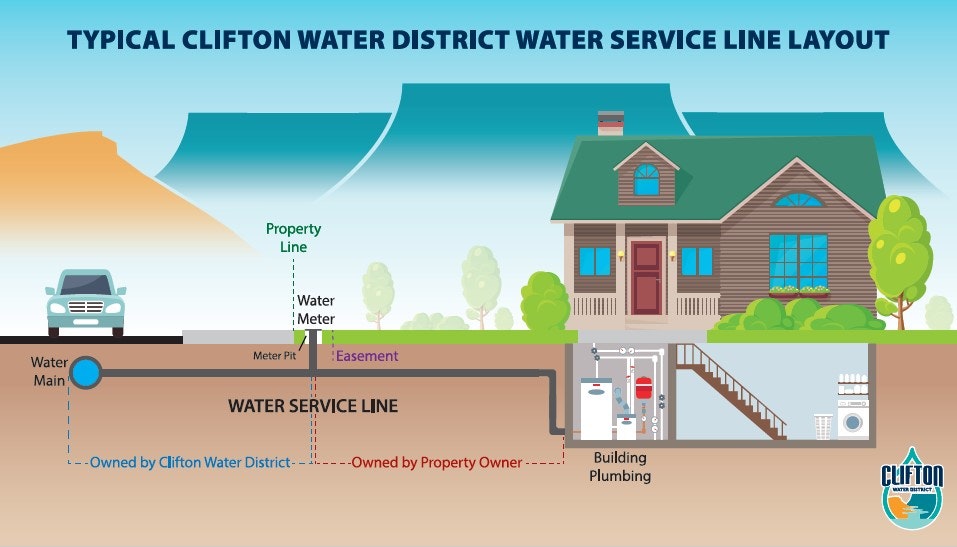
Clifton Water District is responsible for the water line from the road to the meter pit.
The lines from the meter pit to the house and inside the house are the customer's responsibility to maintain and repair.
Water Quality
A chlorine-like smell can be caused by very hot temperatures as chlorine escapes much easier from warm water than cool water. Low river levels will contribute to the higher temperature of the water and an increased chlorine-like smell. If you set your glass of water down for a minute, the smell will dissipate.
If your water smells like rotten eggs or has an earthy / musty odor, fill a clean glass with water from your cold water tap, and then fill a separate glass from your hot water tap. If the cold water smells normal but the hot water has the smell, your hot water heater may need some maintenance.
To ensure the smell is not coming from your sink, or garbage disposal, fill a clean glass with water and take it into another room to see if the smell persists.
You can also flush your taps by running it for about two minutes. If the smell disappears, the internal plumbing of the home is the most likely source. A good way to try and find the source of the odor is by smelling water from all the different taps inside, and outside the home - just remember to use a clean glass for each tap.
If you have any concerns regarding the smell of your water, call 970-434-7328 and our Customer Service team will assist you.
White or cloudy water is caused by air bubbles that are trapped in the water. It is safe to drink and by letting your water sit for a minute or two, the cloudiness will disappear.
If you've seen our crew working in your area, the air in your water was most likely caused by service repairs / replacements performed by our staff. If you live in our Whitewater service area, the white / cloudy water may take a few days before it goes away.
Clifton Water District treats the water with chlorine to kill all harmfull bacteria, virusses, parasites, mold, and algae. Any moldy growth is most likely from spores already present in the house. This could be from a houseplant, or the soil in the pot.
Black particles in the water usually come from the plumbing within the house, caused by corroding or deteriorating pipes, water heaters, and other parts.
Irrigation
Clifton Water District does not provide non-potable irrigation water to customers. If you are experiencing issues with your irrigation water, you can click here (this link takes you to an external website) to see which Irrigation Provider to contact for your service address.
You can click here (this link also takes you to an external site) for a map of the Irrigation Districts.
Billing
Common reasons for increased water use include:
- Warmer temperatures and heavier use of swamp coolers
- Increased outdoor watering of flowers and vegetation
- Household guests
- Leaking toilet flappers
- Dripping faucets
While there isn't much we can suggest for household guests, we do have a few other suggestions.
Leaking Toilets:
The most common and surprising cause of increased usage is a leaking toilet. You can usually hear a toilet that continues to run after a flush, but not always. A toilet that continues to run can waste up to 200 gallons a day!!! The most common toilet leak is a deteriorated or defective flush valve (flapper) ball at the bottom of the toilet tank. If it does not make a tight seal, water will leak into the toilet bowl, and continue to use water refilling.
The following simple test can help you determine if you have a leaking toilet:
- Take the lid off of the tank behind the bowl, flush the toilet, then wait for it to fully refill.
- Put a few drops of food coloring in the tank.
- If you have a leak you will begin to see color in the toilet bowl.
- Wait at least 20 minutes to make sure you suspect a small leak.
- Obtain and install a new flapper unit from the hardware store, or contact a plumber.
Leaking Faucets:
It is important to routinely check your plumbing and home for leaky faucets and leaky valves under sinks and connecting to water-using appliances such as water heaters. These leaks are usually easy to see. Unfixed leaks can waste hundreds and even thousands of gallons of water a month.
We know what a shock it can be to unexpectedly get a high bill. The first step to determine the cause is to check your usage, located on the left side of your billing statement, under METER READ DETAIL.
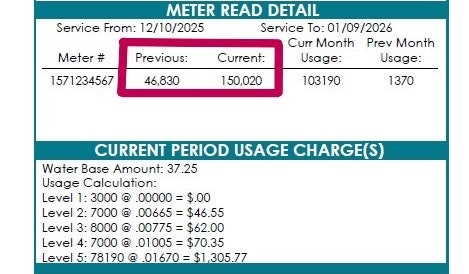
If you usage has increased, but your water usage habits have not, please check your house for leaks and / or drips, and then give us a call at 970-434-7328.
Your bill can also appear to be higher than expected because your payment did not reach our office prior to us creating your billing statement. Your ACCOUNT SUMMARY will show the last payment we received - if it shows $0.00CR, it means we either did not receive your payment at all, or we received it after we printed your billing statement.

Renters / Property Owners / Property Managers
No. Accounts for Water Service must remain in the Property Owner's name. The official Property Owner is identified by the Mesa County Assessor's Office and is the only person authorized to receive detailed account information. However, a Property Owner has the option of selecting a "Third Party Notification" to send a bill to an identified Tenant. See the next question.
We have an option for Property Owners so that your Tenant can receive the Bill in their name. It is called Third Party Notification. There is a $20.00 charge for each new Tenant that would need to be set-up in our billing software. You can click here to fill out our online, Third Party Notification form.
Service Interruptions / Low Pressure
Service interruptions can occur due to the following:
- Planned District maintenance / repairs. The District will notify all customers affected by a planned outage either via text, call, email, or door tags. If you have lost service due to planned maintenance and did not receive notification, the District may not have your current contact information. You can update your contact information here, or give us a call at 970-434-728.
- Unplanned, emergency repairs. The District will notify customers as soon as possible in cases of emergency repairs. Please go to our website for information on current outages.
- Frozen lines. During winter, when temperatures fall below 32 F, waterlines can freeze, especially if perhaps a garage door was left open overnight.
- Major leak. Low pressure, or a complete loss of water, can be a result of a massive leak on the service line, between the meter pit and the residence. This does not happen very often, but checking your front yard for any possible leaks will help eliminate this option.
- Service Discontinuation due to non-payment. Please check your statements to review when last a payment was made to the District. Service is discontinued when a customers has a balance that is more than 90 days in arrears.
Low water pressure is usually caused by a failing Pressure Regulating Valve (PRV). Signs of a failing PRV include fluctuating or persistent low water pressure, extremely high water pressure, or banging / vibrating pipes (water hammer). PRVs typically last 10 to 15 years but incorrect installation, constant pressure fluctuations, and water minerals and sediment can shorten their lifespan.
You can test your own lines with a pressure gauge, available at your local hardware or home improvement store. Readings should typically fall between 40 to 80 psi.

We can accept partial payment as long as it is received in our office by 5:00 pm on the Due Date. Your minum due to avoid disconnect is printed on your Discontinuation of Service notice - see image below. Customers are strongly advised to call and verify that the amount paid is enough to avoid Discontinuation of Service.

